





Why Ayurveda Matters More Than Ever in the Age of AI

Why Ayurveda Matters More Than Ever in the Age of AI
We spend hours every day staring at screens. We scroll, we swipe, we consume. Our nervous systems are flooded with notifications, news cycles, and algorithmic feeds designed to keep us engaged — not to keep us well.
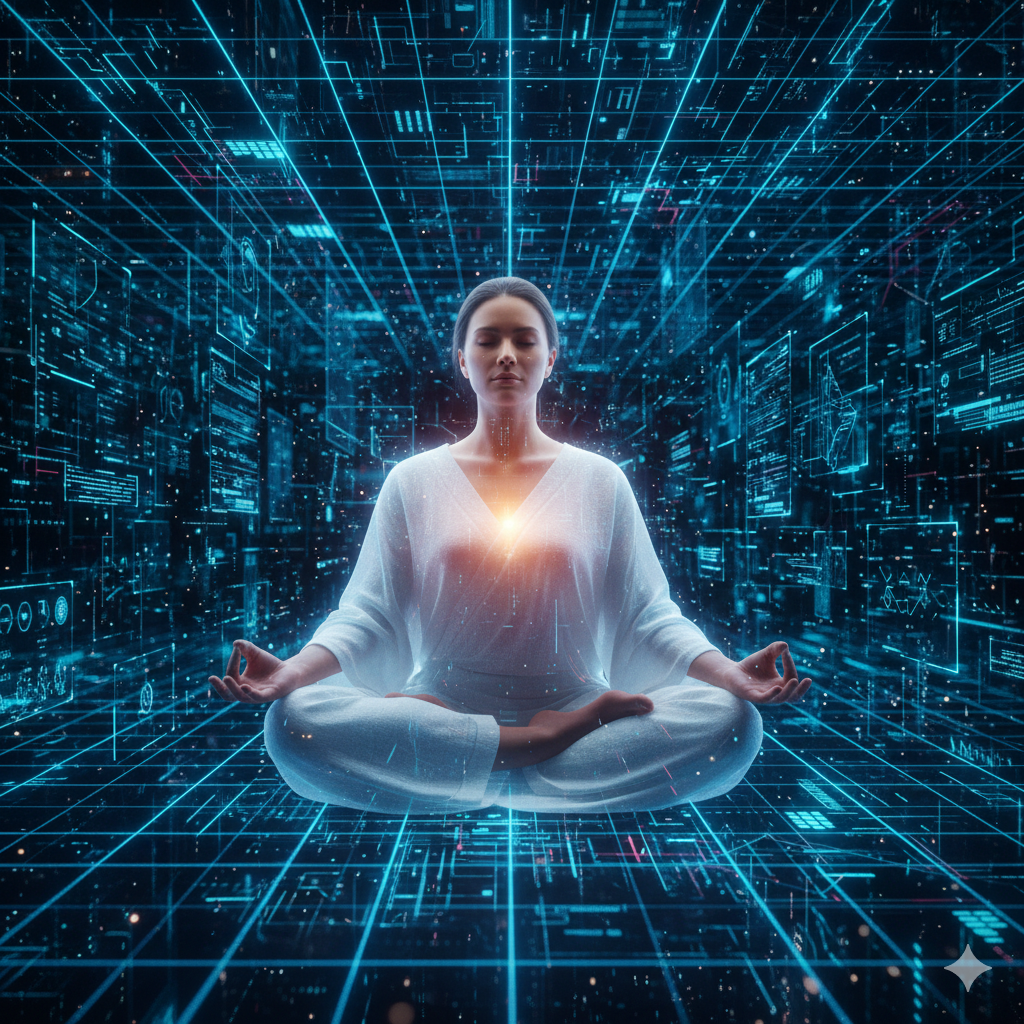
And now, with AI accelerating everything, the pace is only increasing. More information. More stimulation. More speed. The question is no longer whether technology will shape our lives — it already has. The real question is: Who is taking care of the human being inside all of this?
This is where Ayurveda comes in. Not as a relic of the past, but as a living, breathing science of life that we need now more than ever.
The Digital Drug
Dr. David Frawley — one of the most respected Vedic scholars of our time, recipient of India's prestigious Padma Bhushan award, and author of over forty books including his recent Yoga & Ayurveda for Well-Being in the AI & Digital Age — has been sounding this alarm for years. He describes our constant digital stimulation as something akin to a drug. Not a chemical one, but an electrical one that overstimulates our nervous systems, dulls our senses, and erodes our capacity for stillness.
In a talk at the India Foundation in New Delhi in late 2024, Frawley was direct about the limitations of AI: it lacks prana — life force. No matter how sophisticated the algorithms become, AI remains a tool without the animating intelligence that makes us alive, creative, and conscious. He pointed out that our overdependence on technology is linked to a measurable decline in prana and creativity across modern society.
Think about that for a moment. The very thing we celebrate as progress may be depleting the life force within us.
What Ayurveda Understands That Silicon Valley Doesn't
Ayurveda, the ancient Indian science of life and sister tradition of Yoga, has always understood something that our technology-driven culture is only beginning to grasp: health is not just the absence of disease. It is a state of balance — between body, mind, senses, and soul.
Where modern medicine treats symptoms, Ayurveda addresses the root. Where AI processes data, Ayurveda cultivates awareness. Where the digital world fragments our attention, Ayurveda teaches us to restore it — through practices that have been refined over thousands of years.
Dr. Frawley draws a powerful distinction here, rooted in the Upanishadic tradition: there is quantifiable knowledge — the kind AI excels at — and there is eternal, universal knowledge that transcends measurement. Ayurveda belongs to the latter. It works with the subtle dimensions of our being that no algorithm can reach: the flow of prana through our energy channels, the balance of the three doshas (Vata, Pitta, Kapha), the quality of our consciousness itself.
Why This Matters Now
We are at a crossroads. AI is not going away — nor should it. I use it every day. But without the counterbalance of ancient wisdom traditions like Ayurveda and Yoga, we risk becoming what Frawley warns against: people whose minds are increasingly ungrounded, volatile, and reactive. People who crave rapid stimulation but can't sit in silence for five minutes. People who have more information than ever but less understanding of who they actually are.
The symptoms are already showing up everywhere: rising anxiety and depression, shortened attention spans, chronic stress, burnout, sleep disorders, a general feeling of disconnection — from ourselves, from each other, from life itself.
Ayurveda offers a fundamentally different paradigm. It asks: What is your unique constitution? What are you taking in — not just through food, but through your senses, your media, your relationships? What nourishes you, and what depletes you?
These are not abstract philosophical questions. They are the most practical questions you can ask in a world that is moving faster than your nervous system can handle.
The Medicine Is Already Here
Dr. Frawley recommends concrete Ayurvedic and Yogic practices to counter what he calls our increasingly electronic existence: daily pranayama to balance the hemispheres of the brain, meditation and mantra to restore inner quiet, time in nature to reconnect with the Earth, Ayurvedic herbs like Brahmi and Tulsi to nourish the mind and nervous system, and above all — a personal practice, a sadhana, to ground us in something real.
His message is clear: without a conscious effort to care for our inner ecology, the outer technology will only disturb us further. But if we learn to use both wisely — the ancient and the modern — we gain access to something extraordinary. A life that is both connected and conscious. Productive and peaceful. Technologically capable and spiritually awake.
Choose Joy. Choose Life.
This is what I believe in. This is why I do what I do. We don't have to choose between technology and wellbeing. But we do have to choose consciously. We have to bring the same intentionality to our inner lives that we bring to our digital tools.
Ayurveda gives us the framework. Yoga gives us the practice. And teachers like Dr. David Frawley remind us that the deepest intelligence isn't artificial at all — it lives within us, waiting to be remembered.
Life is short. Choose wisely. Choose joy.
References & Further Reading:
- Dr. David Frawley, Yoga & Ayurveda for Well-Being in the AI & Digital Age (2025)
- Dr. David Frawley, Ayurveda and the Mind: The Healing of Consciousness (1997)
- "AI in the Light of Dharmic Science and Wisdom" — Dr. David Frawley at India Foundation, New Delhi (November 2024)
- "How to Cope with the Digital Age with Yoga and Ayurveda for the Mind" — American Institute of Vedic Studies (vedanet.com)