






Is AI Taking Jobs? Anthropic's Labor Market Study
Every time a new AI model launches, the same question echoes across LinkedIn, newsrooms, and boardrooms: Are we all about to lose our jobs?
Anthropic — the company behind Claude — decided to move beyond speculation and actually measure what's happening in the labor market. Their new paper, Labor Market Impacts of AI: A New Measure and Early Evidence, introduces a novel framework called "observed exposure" that combines what AI could theoretically do with what it's actually being used for in professional settings.
And the headline finding? No systematic increase in unemployment for the most AI-exposed workers. At least not yet.
Why This Study Is Different
Most AI labor market predictions rely on theoretical potential — they estimate which tasks could be automated and then extrapolate. The problem is that theoretical capability and real-world adoption are very different things. Just because an AI can authorize a drug refill doesn't mean pharmacies are actually using it for that.
Anthropic's approach is unique because it combines three data sources: the O*NET database of US occupations and tasks, Anthropic's own real-world usage data from millions of Claude conversations (via their Economic Index), and theoretical task exposure ratings from the widely-cited Eloundou et al. (2023) framework.
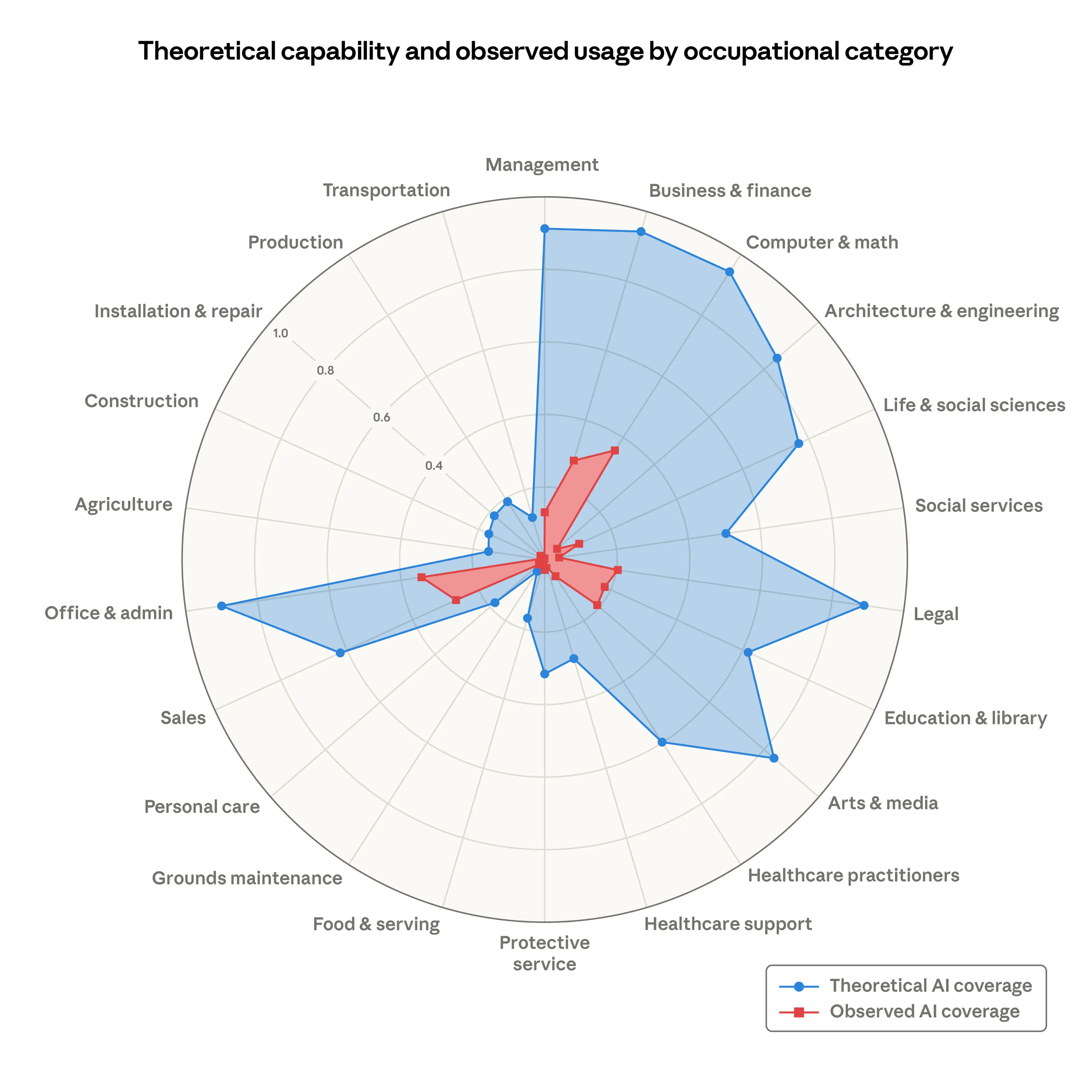
The key insight: AI is far from reaching its theoretical capability. Actual task coverage remains a fraction of what's technically feasible. Even in Computer & Math occupations — the most exposed category — Claude currently covers just 33% of all tasks.
The Numbers at a Glance
75% — Task coverage for Computer Programmers, the most exposed occupation.
30% — Share of US workers with zero AI task coverage in Anthropic's data.
97% — Share of Claude usage that maps to tasks rated theoretically feasible.
47% — Higher earnings for the most AI-exposed workers vs. the unexposed group.
Who's Most Exposed?
The occupations with the highest "observed exposure" won't surprise anyone paying attention to how AI is being deployed in practice. Computer Programmers sit at the top with 75% task coverage, followed by Customer Service Representatives and Data Entry Keyers (67%).

At the other end of the spectrum, 30% of the workforce has effectively zero AI task coverage — think Cooks, Motorcycle Mechanics, Lifeguards, and Bartenders. These roles involve physical, in-person work that current LLMs simply can't touch.
The Exposure Profile: Not Who You'd Expect
Here's where it gets interesting. The workers in the most AI-exposed occupations are not the stereotypical "vulnerable" workforce. They're disproportionately older, female, more highly educated, and significantly better paid. Graduate degree holders are nearly four times as common in the high-exposure group compared to the zero-exposure group.

This flips the usual automation narrative on its head. Unlike previous waves of automation — which mainly affected manufacturing and lower-wage work — AI's displacement risk is concentrated among knowledge workers.
So... Are People Losing Jobs?
The short answer: not yet, with one potential exception.
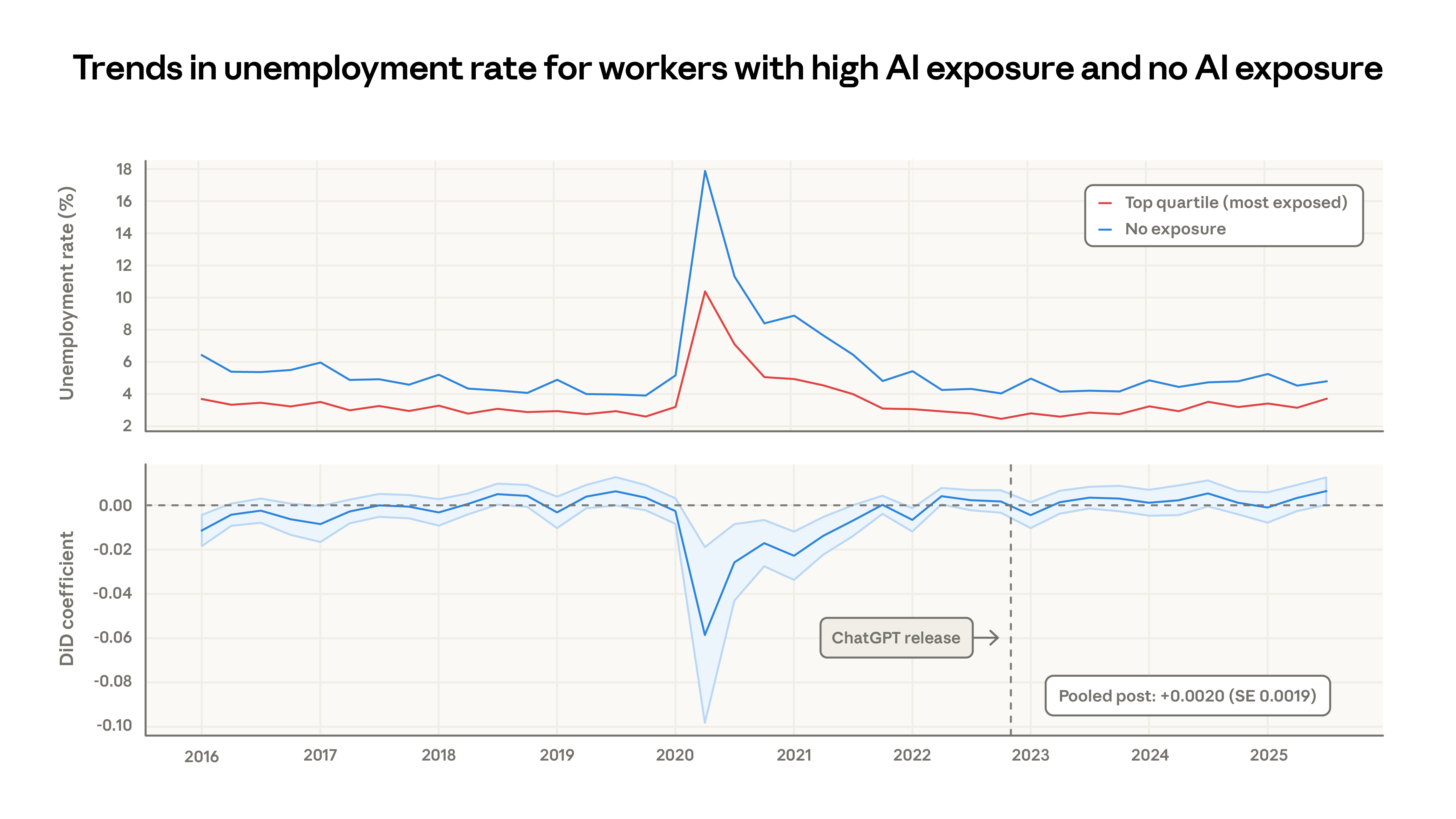
Looking at unemployment data from the US Current Population Survey, the researchers found no statistically significant increase in unemployment for workers in the most AI-exposed occupations compared to unexposed workers since ChatGPT's release in late 2022.
The Young Workers Signal
There is, however, one signal worth watching: hiring of workers aged 22–25 appears to be slowing in AI-exposed occupations. The data shows roughly a 14% drop in the job-finding rate for young workers entering high-exposure roles, while entry into less exposed jobs remains stable.
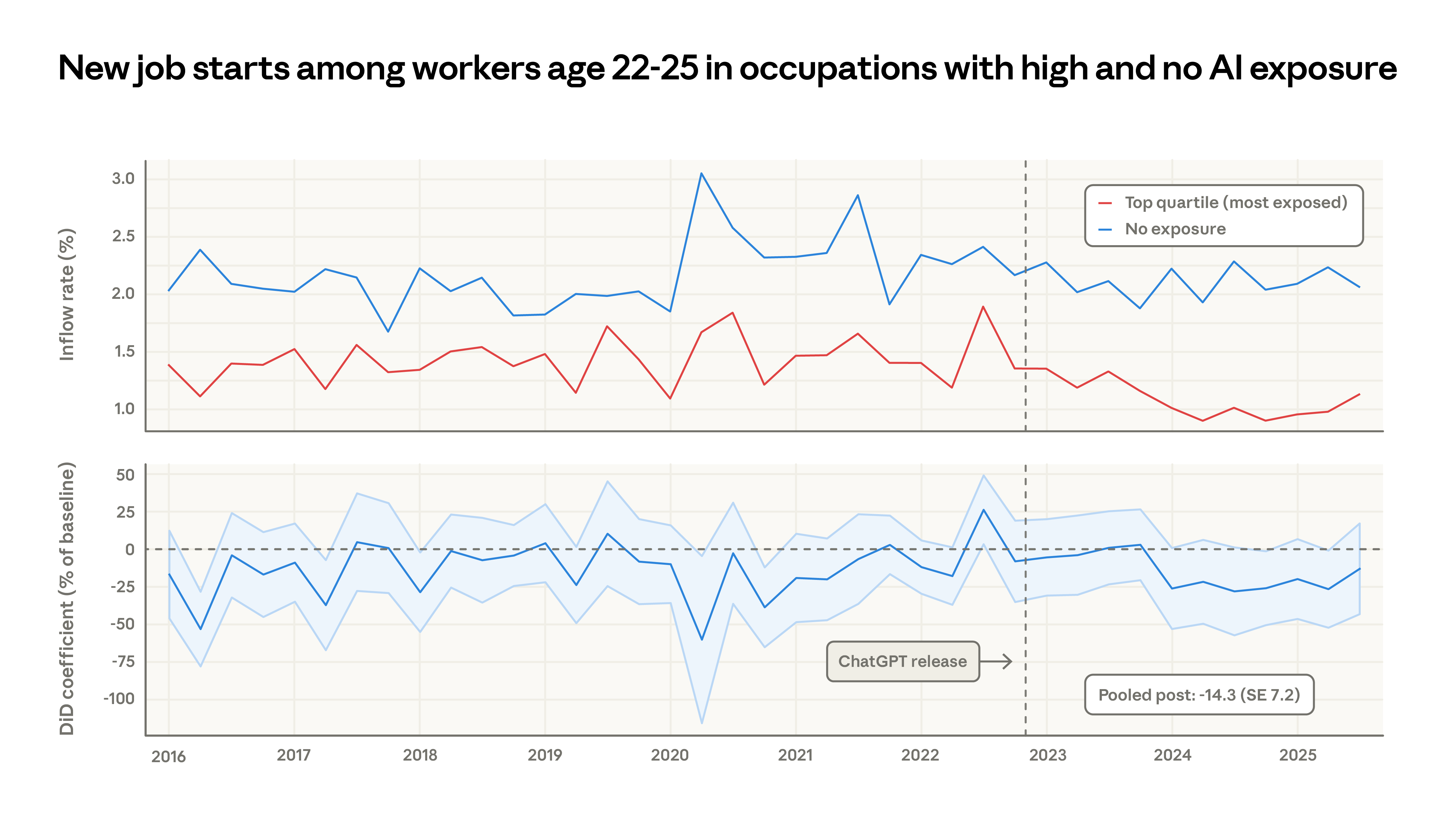
This echoes findings from other researchers (Brynjolfsson et al.) and suggests that AI's earliest labor market impact may not be mass layoffs, but a quiet slowdown in entry-level hiring. Companies don't fire people — they just stop hiring new ones, or hire fewer.
A critical nuance: The young workers who aren't being hired into exposed roles may be staying at existing jobs, taking different positions, or going back to school. The data doesn't tell us whether this represents genuine displacement or career pivoting.
What This Means for Entrepreneurs and Freelancers
For entrepreneurs and freelancers, here are the most relevant takeaways:
- The gap between AI capability and actual adoption is massive. There's a huge runway of theoretical AI potential that hasn't been realized. This is where the opportunity lies — helping businesses implement what's already technically possible.
- Augmentation still dominates over automation. Anthropic's framework weighs automated use more heavily, but the majority of professional AI use is still augmentative. Nobody is being replaced — the tools are simply getting better.
- Entry-level disruption is real. For anyone early in their career, relying on skills that AI handles well (basic coding, data entry, customer support scripts) is risky. The move is to develop expertise that sits on top of AI capabilities, not underneath them.
- The "red area" is growing. The paper's most powerful visual metaphor is the gap between theoretical capability (blue) and actual usage (red). That red area will expand. Positioning where it's growing fastest is the smart play.
An Honest Study From the Source
What stands out most about this paper is its intellectual honesty. Anthropic is essentially publishing data that shows their own product hasn't yet caused the labor market disruption that headlines often predict. They're not claiming AI is harmless — they're building a measurement framework before the effects become unmistakable, so that when changes do arrive, we'll be able to spot them early.
As the authors put it: "This framework is most useful when the effects are ambiguous — and could help identify the most vulnerable jobs before displacement is visible."
That's exactly the kind of sober, evidence-based thinking the AI conversation needs more of.
Read the full study: Labor Market Impacts of AI: A New Measure and Early Evidence — Anthropic Research, March 5, 2026. Written by Maxim Massenkoff and Peter McCrory.