






The .md File Is Quietly Becoming the New Standard
It Started as a Developer Shortcut
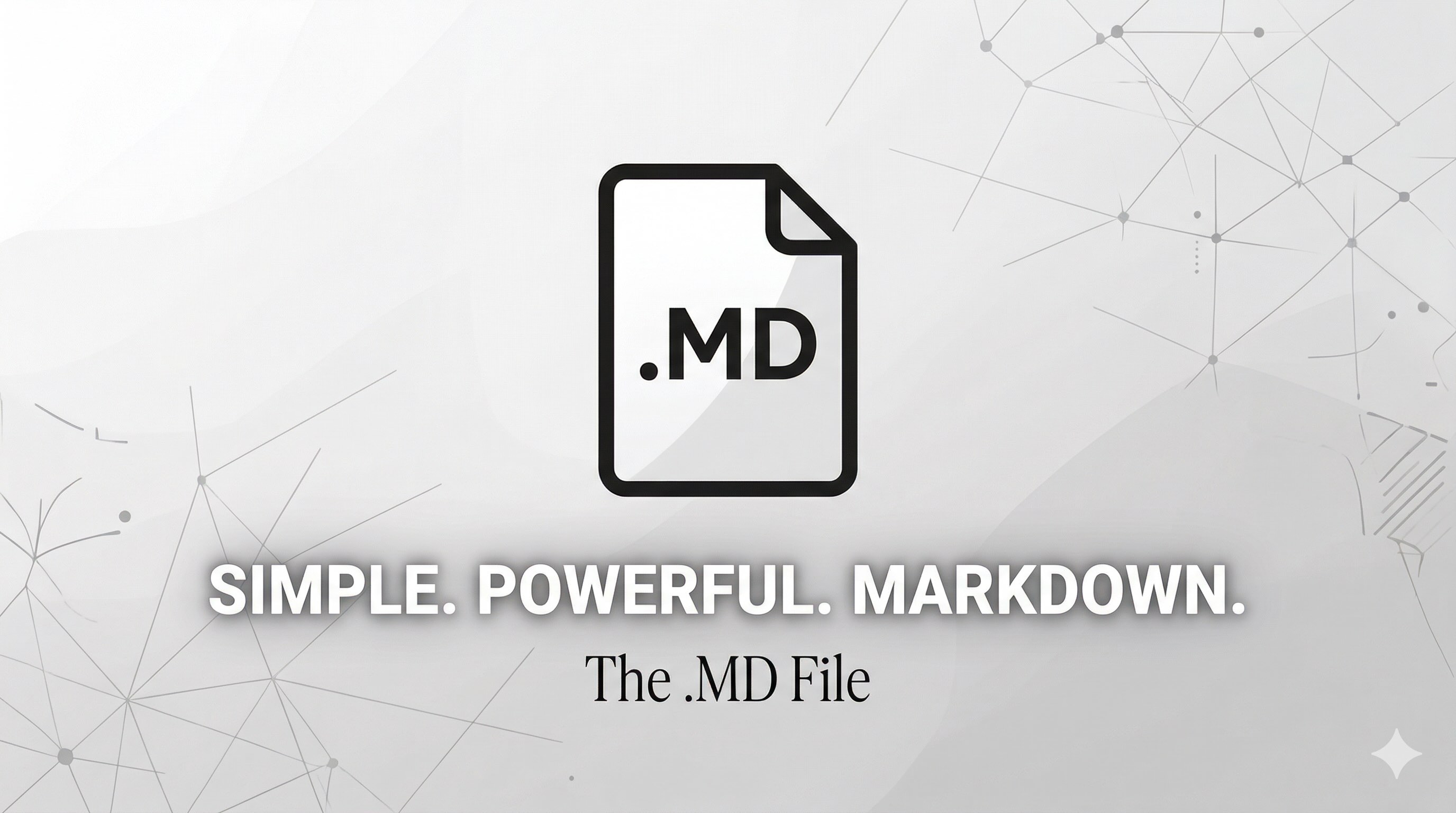
When John Gruber introduced Markdown in 2004, the goal was modest: make it easy to write text that converts cleanly to HTML without looking like code. Two decades later, that humble .md file has quietly outgrown its origins — and is now at the center of how the entire knowledge economy operates.
From GitHub READMEs to Obsidian vaults. From Claude's output to the /llms.txt specification. From static site generators to enterprise documentation pipelines. The .md file isn't just surviving — it's winning.
Why Markdown Won
The answer isn't feature richness. It's the opposite. Markdown won because it does less. A .md file is plain text with minimal formatting symbols. No proprietary binary format. No vendor lock-in. No compatibility headaches across decades of software updates.
A Markdown file written in 2004 opens perfectly in 2026. Try saying that about a WordPerfect file from the 1990s — or even a .docx created in Office 2007.
This simplicity creates three compounding advantages:
Portability. Move a .md file between Obsidian, Notion, VS Code, GitHub, Hugo, Astro, or any of hundreds of tools. The content travels without friction.
Durability. Plain text doesn't decay. There's no format to become obsolete, no software dependency to break. The file is the content.
Readability. Even without rendering, a Markdown file makes sense to a human reader. Headers are obvious. Lists are clear. Structure is visible in the raw text.
The AI Accelerant
Here's what changed the trajectory: large language models love Markdown.
When an LLM processes a document, format matters enormously. HTML buries meaning in tag soup. PDFs lose structure during text extraction. JSON and XML add overhead that burns through context windows without adding semantic value.
Markdown sits in the sweet spot. It preserves document hierarchy — headings, subheadings, lists, code blocks, emphasis — while using minimal tokens. A well-structured .md file gives an AI model immediate understanding of what's a main topic, what's a subtopic, and how ideas relate to each other.
This isn't theoretical. Research from late 2025 showed that GPT-3.5's performance varied by up to 40% depending on whether prompts were formatted in plain text, Markdown, JSON, or YAML. Markdown consistently delivered the best balance of clarity and efficiency.
For Retrieval-Augmented Generation (RAG) workflows — where AI models pull from knowledge bases to answer questions — Markdown has become the de facto input format. The semantic structure means better chunking, better retrieval accuracy, and better answers.
The /llms.txt Movement
Perhaps the clearest signal that Markdown has crossed a threshold: the /llms.txt specification. Proposed as a complement to robots.txt, it suggests websites add a Markdown file at their root that gives AI agents a curated, structured overview of the site's content.
The thinking is simple. LLMs can't efficiently process entire websites. Context windows are too small, and converting complex HTML with navigation, ads, and JavaScript into usable text is messy. A clean .md file at /llms.txt solves that — one file, structured for both human and machine consumption.
Major documentation frameworks like Docusaurus, VitePress, and nbdev already generate Markdown versions of all pages by default. The infrastructure is being built around the assumption that .md is the universal interchange format.
Where .md Is Now the Default
The list keeps growing:
Software documentation. Every serious open-source project ships a README.md. GitHub, GitLab, and Bitbucket render it automatically.
Note-taking. Obsidian, Logseq, Bear, and Typora all store notes as .md files. The content stays portable if the app disappears tomorrow.
Static websites. Jekyll, Hugo, Astro, Eleventy — they all turn folders of Markdown files into complete websites.
AI system prompts and configuration. Claude, ChatGPT, and most AI coding tools use Markdown for structuring instructions, system prompts, and output formatting.
Team communication. Slack, Discord, Reddit, Microsoft Teams — all support Markdown formatting inline.
Knowledge management. Enterprise teams converting their internal wikis to Markdown for RAG-based AI search report measurable improvements in retrieval accuracy.
The Bigger Picture
There's something philosophically interesting happening here. In a world racing toward complexity — AI agents, multi-modal models, agentic workflows — the format that's winning is the simplest one imaginable. Plain text with a few symbols.
Markdown doesn't try to be everything. It doesn't handle advanced page layouts. It doesn't embed interactive widgets. It's not a database. And that's precisely why it keeps winning. Every tool can read it. Every AI can parse it. Every human can understand it.
The .md file has become the lingua franca of the knowledge economy — not by being the most powerful format, but by being the most interoperable one.
For anyone building content, documentation, or AI-powered workflows in 2026: if the output isn't in Markdown, it probably should be.